
NFHS Institutes Pitch Counts, Affects Announcers
August 23, 2016 · Jarrod Wronski

The National Federation of High Schools has made a change to baseball rules effective this upcoming season that will affect P. A. announcers across the country. Unlike the rules instituted
NFHS: Pitching Restrictions Policies in Baseball to be Based on Pitches
Little League Baseball has had pitch limits for years now and it’s aimed to prevent pitchers from throwing too many pitches and suffering injuries that could affect their well-being after their baseball life has completed. However, pitchers at higher levels have not necessarily had those pitch limits, until now.
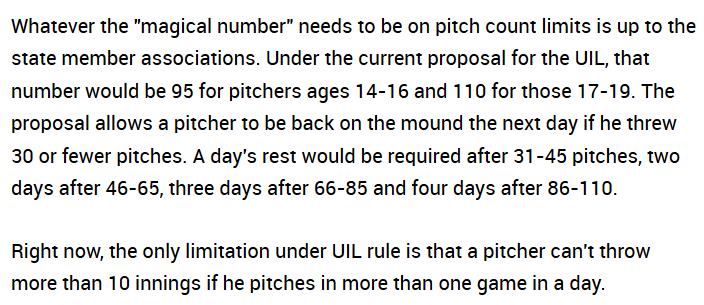
From http://www.chron.com/sports/highschool/article/UIL-to-implement-pitch-count-for-2016-17-baseball-8355432.php by Adam Coleman
“Each NFHS member state association will be required to develop its own pitching restriction policy based on the number of pitches thrown during a game to afford pitchers a required rest period between pitching appearances,” according to the NFHS.
Tally Counter Store: 4 Easy Ways to Keep a Little League Pitch Count
This means that each state will be deciding the pitch limits and how much time each pitcher will need to take off between outings. This also means teams will have to have more than one or two players who can pitch and will open up the game more on the offensive side.
Virginia High School League: VHSL Baseball Pitch Count Timeline (PDF)
Where this affects P. A. announcers will be if the states decide to also incorporate Little League’s method of tracking and announcing the pitches at the end of each half inning. Currently, at Little League tournaments, P. A. announcers are required to announce the number of pitches thrown by the current pitcher at the end of the inning. This is in conjunction with an official pitch counter who is also working the game. If the state institutes these kinds of changes, then pressboxes could see some new faces this year.
Chron (Texas): UIL to implement pitch count for 2016-2017 baseball season
How will the states cope? Well, right now they’re working on it and below are some possible scenarios.
Official scorer will also track the number of pitches
This seems the most obvious of all scenarios. Having worked Little League tournaments, it would be a good idea to have two people handle these roles. Why? If the official scorer is using a scorebook and forgets to track the number of foul balls after two strikes or forgets to count the ball in play when counting pitches, you can run into a situation where counts are wrong. Having a person in charge of tracking all the pitches will help put in a system of checks and balances. This works even better if the P. A. announcer also keeps a scorebook while announcing. It’s easier than it seems and takes a couple of games to get the hang of. Both teams should have someone tracking the pitches for each team to allow for a better system of checks-and-balances.
P. A. announcer will track the number of pitches
Since most high schools don’t run a full-on show like you see at college and professional level, this could be another solution. In cases where the announcer is not in a pressbox, this could be an issue. It really isn’t that hard to make a tick mark on a piece of paper after each pitch, it requires the announcers to pay a little more attention. Most good and professional announcers don’t have a problem doing this. If this does fall upon the announcer, it would be recommended to get a digital or clicker counter from an office supply store or simply order one from www.tallycounterstore.com with many options available under $20.
An Official Pitch Counter will be required
This is most likely what is going to happen. Every team has a parent, student-manager or players who aren’t playing in the game that can do this. While handing this off to a responsible person is preferred, there still will be some issues that arise, but that’s going to happen across the board. Ultimately, coaches are still going to be responsible for the well-being of their pitchers.
Communication needs to be required as each team should track pitches for both teams. Not all scoreboards, yet, have the ability to track the number of pitches thrown and some scoreboard operators may not necessarily know how to reset the count once the game has started. There will be growing pains with this, but a 10-minute delay here and there is better than a young athlete having to undergo surgery because they threw too many pitches. Games will also take a little longer as there will be the possibility of more pitching changes in games, but that will work its way out as more coaches get used to the new limits.
For announcers, how will the required information be communicated, or will the information be required to be announced? This has been left up to the individual state high school associations and if you are a baseball announcer, this is the time of year to start talking to your baseball coach to find the answer. In some states like Virginia (linked above) and Florida, the final decision wont be made until closer to the start of the season, where Texas (linked above) already seems to have it worked out.
If you are required to make the announcement, it’s as simple as adding one line to your end-of-inning recap:
“For the Bobcats in the second, no runs, no hits, no errors and nobody left on base. For Micah Rawlings, he has now thrown 27 pitches.” The number of pitches in the inning doesn’t matter, just the cumulative number. Also, announcing the team the pitcher is throwing for is unnecessary because you’ve already announced the batting team, and there’s only two teams in a baseball game so it’s information that doesn’t quite matter.
If you don’t do an end-of-inning recap, you can simply announce the following:
“Micah Rawlings of the Sentinels has now thrown 27 pitches.”
If you’re in a position in which you don’t get the information immediately, make it part of your lead-off announcement to start the next inning:
“Ladies and gentlemen, for the Sentinels, Micah Rawlings has thrown 27 pitches. [Leave a pause] Leading off the third for the Sentinels, the right fielder, number 2, Eric Mancini.”
Little League hasn’t required to have the announcer recognize each milestone pitch (15, 25, etc.), just the number at the end of the inning. It’s quite possible that states will ask for this, if so, then the announcer is going to need to focus attention to the field at all times. It does seem extreme to require this, especially if both teams are tracking this information, and the pitch count is being announced at the end of each inning.
One question that has been raised has been from the softball side. While there are some who feel there should be pitch counts in softball, none have been approved yet.